The Challenge of Modern Assessment
Across schools, universities, and training institutions, educators are facing a growing challenge. Class sizes are increasing, coursework is becoming more complex, and expectations for detailed feedback continue to rise.
Marking is no longer just about assigning a grade. It involves evaluating reasoning, aligning responses with learning outcomes, and providing constructive insights that help students improve. Doing this consistently across large cohorts can be time intensive and difficult to scale.
Educators need support that enhances the process without compromising fairness or academic standards.
Why Traditional Marking Alone Is Becoming Unsustainable
Manual evaluation works well in smaller settings, but modern learning environments demand efficiency alongside quality. When educators must review hundreds of submissions, maintaining consistency across marking can become difficult.
Common challenges include:
• Time constraints that limit detailed feedback
• Variability in grading across markers or departments
• Difficulty aligning assessments closely with rubrics
• Limited ability to provide personalised insights at scale
• Administrative workload reducing time for teaching and mentoring
The goal is not to replace educators, but to reduce repetitive tasks so they can focus on meaningful evaluation.
A Structured Approach to Smarter Assessment
AI-supported marking systems introduce a structured way to evaluate submissions against clearly defined criteria while keeping educators in control of the final judgment.
1. Alignment with Rubrics: Assignments are evaluated directly against uploaded rubric criteria, ensuring grading reflects intended learning outcomes.
2. Consistent Evaluation Across Submissions: Each submission is reviewed using the same framework, helping reduce unintended variation.
3. Evidence Based Feedback: Instead of general comments, students receive feedback tied to specific sections of their work.
4. Faster Turnaround Without Losing Quality: Automation reduces repetitive review time, allowing educators to focus on interpreting results and guiding improvement.
5. Transparency in Assessment: Clear performance indicators help both educators and students understand how outcomes were determined.

Auto Marking Structured Grading
Supporting Educators Rather Than Replacing Them
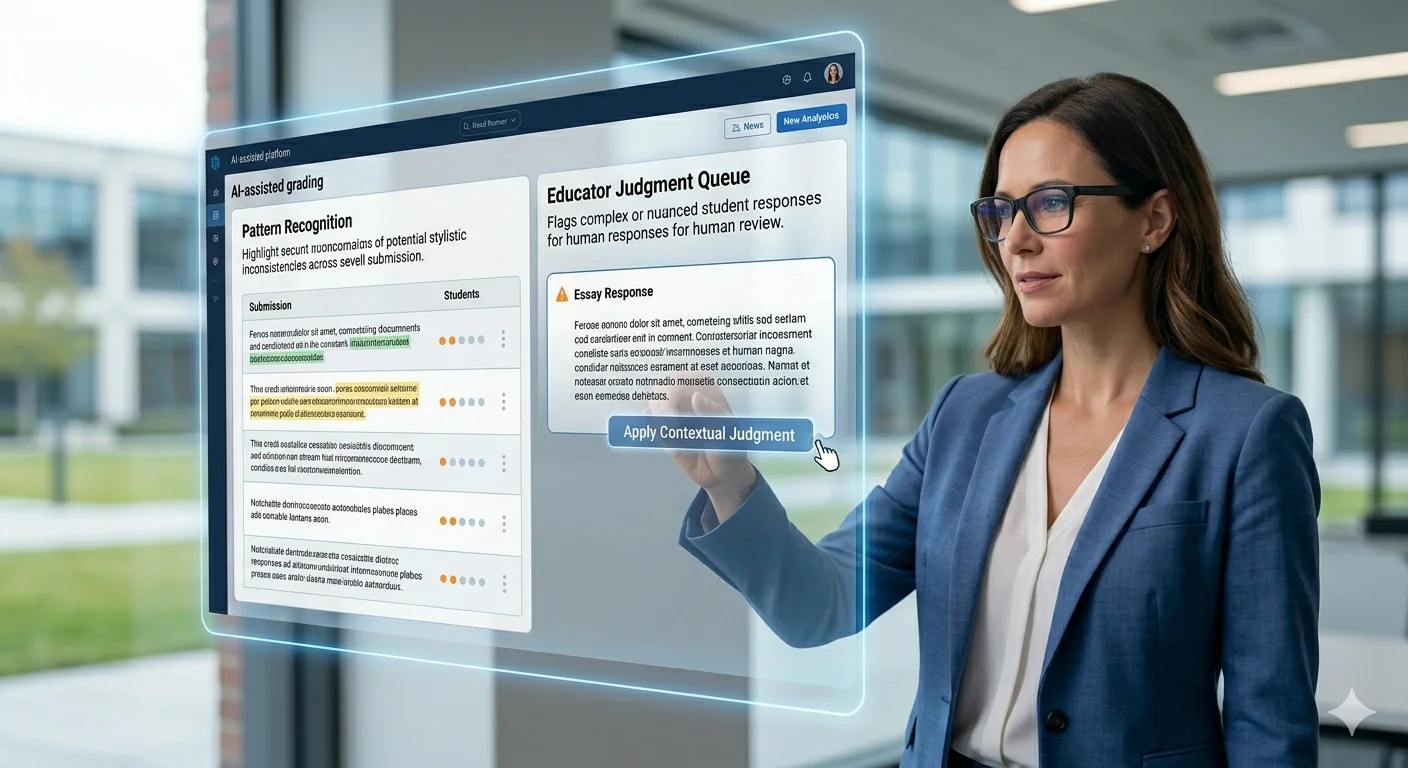
One of the biggest misconceptions about AI in assessment is that it removes the human role. In practice, well designed systems act as an assistant, not a decision maker.
Educators remain responsible for:
• Setting assessment criteria
• Reviewing flagged insights
• Interpreting complex responses
• Providing contextual judgment
• Ensuring fairness across unique cases
Technology handles pattern recognition and consistency, while educators provide expertise and academic context.

Auto Marking AI analysis and educator review
Benefits for Students as Well as Educators
Smarter marking does not only reduce workload. It improves the student experience by delivering clearer, faster, and more actionable feedback.
Students gain:
• Faster insight into performance
• Greater clarity on how to improve
• Fairer evaluation across cohorts
• Confidence that grading follows defined standards
• More time to apply feedback before future assessments
This creates a learning cycle where assessment actively supports development rather than simply measuring outcomes.
Connecting Assessment to Career Readiness
In professional environments, performance is evaluated against structured criteria, measurable outcomes, and clear expectations. By aligning academic assessments with similar principles, institutions prepare students for how their work will be reviewed in real workplaces.
Consistency, transparency, and evidence based evaluation are not just academic ideals. They are professional realities.
Smarter assessment systems help bridge that gap between education and employment.